





Bitcoin gives individuals something rare: the ability to hold wealth without relying on a bank, broker, or custodian. That is one of its greatest strengths.
It is also what makes inheritance unusually difficult.
With traditional assets, there is usually an institution in the middle. A bank can freeze an account, verify documents, work with courts, and transfer control. Bitcoin does not work that way. The network does not recognize heirs, death certificates, probate filings, or customer-service requests. It recognizes keys and spending conditions.
That creates a simple but serious problem: the same steps that make bitcoin hard to steal can also make it hard to pass on.
Why It’s Different
Bitcoin inheritance is fundamentally a recovery-design problem: who can access the coins, under what conditions, and with what safeguards.
The first challenge is the tension between security and accessibility. During your lifetime, you want strong protection against theft, physical coercion, and mistakes. After your death or incapacity, you want a clear recovery path for the people you trust. Those goals often pull in opposite directions.
The second challenge is complexity. Many strong Bitcoin setups, especially multisig, make good sense to the person who built them. They may make far less sense to a spouse, child, trustee, or executor who does not use Bitcoin every day. A plan that only works for a calm, technical operator may fail when real recovery actually becomes necessary.
The third challenge is privacy. Inheritance planning can expose sensitive information about who owns bitcoin, how much may exist, and who is expected to receive it. A weak setup can create unnecessary risk for both the owner and the heirs.
The fourth challenge is time. A true inheritance plan may need to work years or even decades from now. That means the plan has to be judged not only on whether it works today, but on whether it can outlive devices, assumptions, and even the companies involved in setting it up.
That last point matters more than many people realize. An inheritance plan that depends on a provider being around forever may be convenient, but it is not especially durable.
Six Questions To Ask
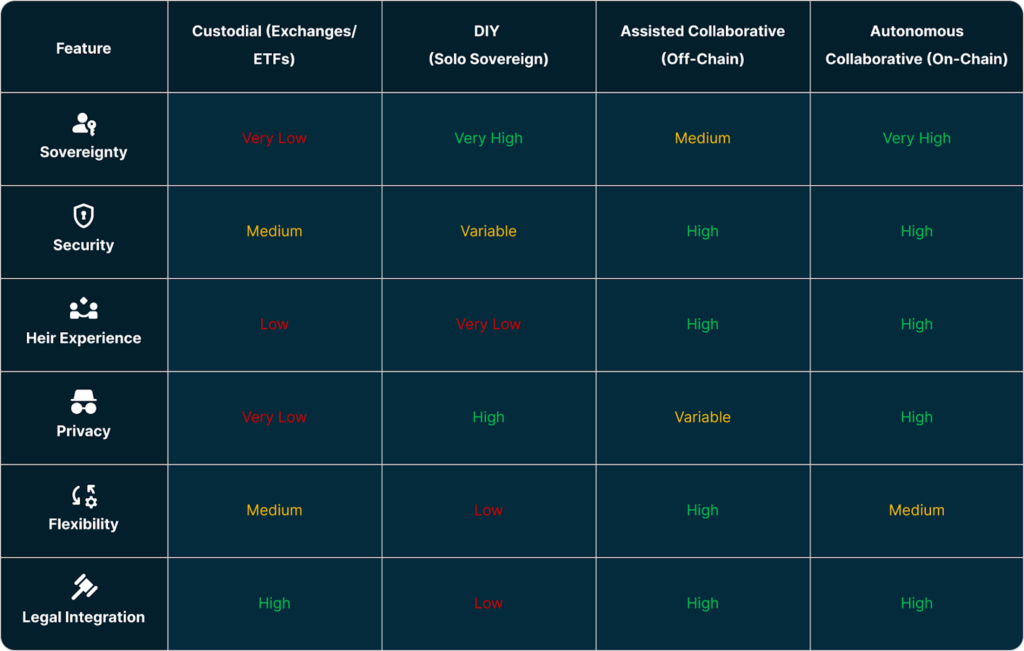
Every Bitcoin inheritance approach makes trade-offs. The easiest way to compare them is to ask six questions:
- Sovereignty: Does it preserve sovereignty, or does it depend on a company, custodian, trustee, or legal process to work?
- Security: Does it protect the bitcoin during your lifetime against theft, coercion, and accidental loss?
- Heir Experience: Can the intended heirs realistically recover the funds without confusion or dangerous mistakes?
- Privacy: How much sensitive personal or financial information does the setup expose?
- Flexibility: How easy is it to update the plan when beneficiaries, timelines, or circumstances change?
- Legal Fit: Can it work alongside a will, trust, or trustee if needed?
No single setup maximizes every category. But these six questions make the trade-offs easier to see.
Four Ways People Solve It
1. Custodial inheritance
The most familiar route is to leave bitcoin with an exchange, broker, ETF, or other custodian and let the traditional legal system handle the transfer.
The appeal is obvious. The account is already tied to an identity. There may be account statements, support desks, and a clearer legal process for heirs to follow.
But the trade-off is also obvious: the institution controls the keys. That means access depends on its policies, its compliance procedures, its jurisdiction, and its long-term survival. Heirs may need to deal with both the legal system and the platform before anything is released. Sensitive customer data can also be concentrated in one place, creating privacy and security risks that do not exist in the same way with self-custody.
This can work. But it solves the inheritance problem by giving up much of what makes self-custodied bitcoin different.
2. DIY inheritance
DIY inheritance covers a wide spectrum. At one end is the simple singlesig handoff: leaving a seed phrase, hardware wallet, or full recovery backup for an heir. At the other end are advanced multisig and timelock setups built with open-source tools.
Those should not be judged as if they were the same thing.
From a security standpoint, the weakest version is the simple singlesig handoff. Every extra seed backup becomes another theft target, especially when one person or one location can unlock the wallet. That risk goes up further when the owner leaves complete recovery materials in a home safe, office drawer, or deposit box with no extra structure.
Adding a BIP39 passphrase can improve that setup, but it introduces its own risks. There is no checksum to catch a transcription mistake. A short passphrase may be too easy to brute-force. A long or unusual passphrase can create a different failure mode: the owner or the heirs may not reproduce it exactly years later, locking themselves out of the wallet.
At the other end of the spectrum, well-designed DIY multisig or timelock setups can be highly robust. Many experienced Bitcoiners prefer this path for good reason. The trade-off is operational. Setup, maintenance, and recovery put more responsibility on the owner and the heirs, often without expert help when something goes wrong.
DIY can offer very strong sovereignty and security when executed well. It simply asks more of everyone involved.
3. Provider-assisted collaborative custody
A middle ground is collaborative custody. In this model, the owner uses a multisig setup, but a provider helps with onboarding, key management, recovery, and inheritance procedures.
This is a real improvement over both pure custody and pure DIY. The owner keeps more control, while heirs get help when they need it.
Many services in this category run the inheritance logic off-chain. Waiting periods, liveness checks, beneficiary arrangements, and recovery procedures are coordinated through the provider’s system rather than embedded directly in Bitcoin’s spending conditions.
That has real advantages. Off-chain inheritance is often easier to update. If the owner wants to change a beneficiary, adjust a waiting period, or support a more tailored or phased distribution plan over time, that is usually easier to do off-chain than in a fully on-chain setup.
The trade-off is resilience. The inheritance path may still depend on the provider being available and willing to assist when the claim is made.
For many families, this is still a strong option, especially when guided recovery and flexibility matter most.
4. On-chain collaborative inheritance
A newer model combines collaborative support with an on-chain fallback.
Here, the owner still gets multisig security and provider guidance. But the inheritance recovery path is also reflected in Bitcoin’s spending rules. A timelock can change the conditions for spending after a set period, giving heirs a route to recover even if the provider is unavailable.
That changes the risk profile in an important way. The recovery path is anchored in Bitcoin’s spending rules, rather than relying solely on a provider’s continued participation.
This model does come with trade-offs. Because part of the plan is enforced on-chain, some changes can be less convenient. Adjusting the inheritance timelines or changing the structure may require moving funds and paying network fees.
Still, for holders who want collaborative support with a stronger long-term backstop, on-chain inheritance is an important step forward.
The Real Trade-Off
The most useful way to compare modern inheritance solutions is not to ask which one is universally best. The better question is what you want to optimize.
Off-chain collaborative designs usually win on flexibility. They are easier to update, easier to adapt as families change, and often easier to tailor over time.
On-chain collaborative designs usually win on durability. The fallback path is built to survive provider failure, which matters when an inheritance plan may need to work years or decades from now.
Many families could reasonably choose either one. The right fit depends on what matters most.
For anyone treating bitcoin as generational wealth, that kind of durability belongs in the core design.
A Smooth Path And A Failsafe
Most Bitcoin inheritance systems lean too far in one of two directions.
Some optimize for convenience. They are easy to understand, but they rely heavily on institutions, identity checks, or provider discretion.
Others optimize for sovereignty. They minimize trust, but they push too much technical complexity onto heirs at exactly the wrong moment.
The strongest model combines two paths.
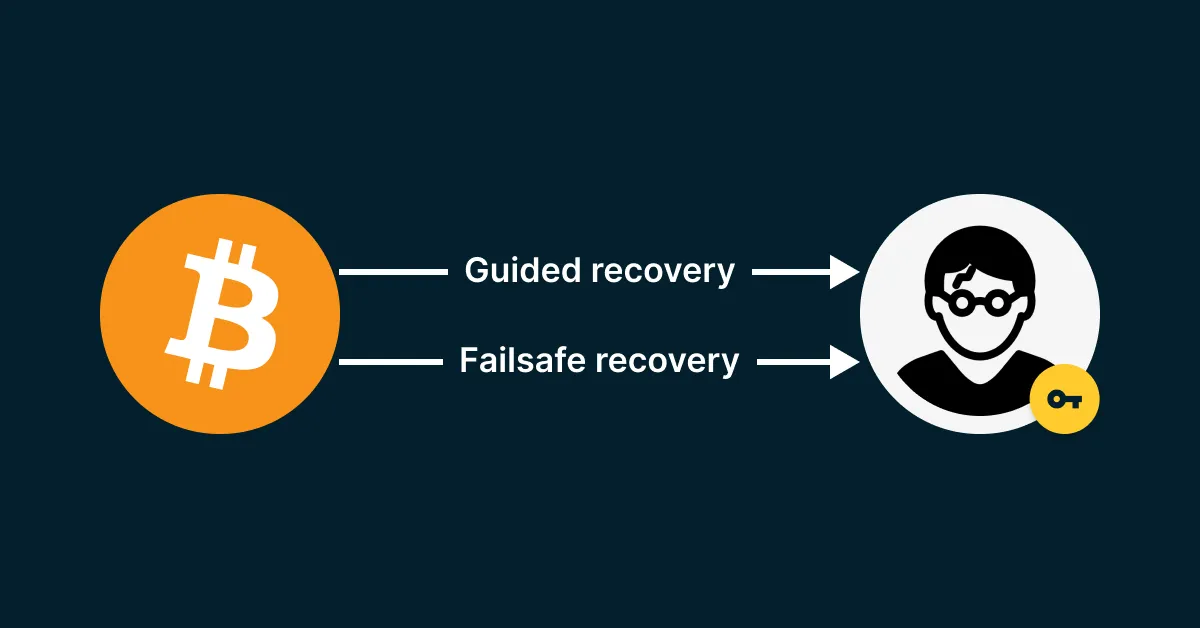
The first is a smooth path: a guided recovery route that heirs can use when the provider is available and everything is working as expected. This lowers stress, shortens the learning curve, and reduces the chance of costly mistakes.
The second is a failsafe: a recovery path enforced by Bitcoin itself, so the plan remains executable even if the provider disappears.
That combination matters because it matches how real inheritance works. Most people would prefer that their heirs get support instead of navigating a complex recovery alone. At the same time, few people want their legacy to depend forever on one company’s survival.
What This Looks Like In Practice
Nunchuk is one provider working across both collaborative models.
Its off-chain inheritance setup is a strong fit for users who expect the plan to change over time. Because the inheritance logic is coordinated off-chain, the plan is easier to revise when beneficiaries, waiting periods, or distribution preferences change. That flexibility can matter for families whose circumstances are likely to evolve.
Its on-chain inheritance setup is aimed at a different priority. There, collaborative support remains, but the fallback recovery path is enforced through on-chain timelock conditions. If Nunchuk is available, heirs can recover with guidance. If Nunchuk is unavailable, recovery can still continue through the on-chain path once the relevant conditions are met.
This is the broader trade-off in plain terms. Off-chain collaborative inheritance usually gives you more flexibility. On-chain collaborative inheritance gives you a stronger guarantee that the plan can outlive the provider.
A reader does not need to pick sides philosophically to see why that distinction matters. It is simply a question of which trade-off fits the family and the time horizon best.
Estate Planning Still Matters
A common misconception is that Bitcoin inheritance must be either fully informal or fully absorbed into the legacy financial system.
In practice, many families need a hybrid approach.
Some holders want bitcoin to pass directly and privately to heirs. Others want a trustee involved, whether for staged distribution, protection of minor beneficiaries, or alignment with an existing trust. Some want legal documentation to clarify intent while keeping the actual access path separate from public probate records.
A good Bitcoin inheritance setup should allow for those choices.
That is why it helps to separate two questions: who should receive the asset, and who can actually recover it.
A will or trust can describe intent, define beneficiaries, and create legal duties. It does not, by itself, solve the access problem. At the same time, a purely technical recovery path does not remove tax, reporting, or estate-law considerations.
The strongest plans handle both layers deliberately.
Common Mistakes
A surprising number of inheritance plans fail for ordinary reasons.
One common mistake is assuming that a spouse, child, or executor will “figure it out.” Owning a hardware wallet is not the same thing as understanding recovery.
Another is concentrating too much power in one place. A single document, device, or envelope that completely unlocks the funds may simplify inheritance, but it may also simplify theft.
A third is overestimating the safety of passphrases without thinking through the human side of recovery. A passphrase can strengthen a singlesig setup, but only when it is created, stored, and communicated with real operational discipline.
And finally, many people build a plan once and never revisit it. Beneficiaries change. Devices fail. Relationships evolve. A Bitcoin inheritance plan is not a static artifact; it is a system that should be reviewed over time.
A Simple Checklist
An inheritance plan can start simple, as long as each step is intentional and periodically reviewed.
Start by deciding who should receive your bitcoin and whether those people can handle self-custody directly. Some heirs may be comfortable inheriting bitcoin itself. Others may need a trustee, staged access, or guided support.
Next, choose a security model that matches both the size of the holdings and the capabilities of the people involved. For larger amounts, multisig and a more formal inheritance design become far more important.
Then separate secrets from instructions. In many cases, the keys, the devices, and the “map” explaining how recovery works should not all be stored together or entrusted to a single person.
After that, decide which trade-off matters more in your case. Some families benefit most from flexible off-chain coordination. Others care more about having an on-chain fallback that can outlive the provider.
Then test the plan. Not with the full amount, but enough to know whether the intended recovery path is usable. A plan that has never been rehearsed is often just a theory.
Finally, review the setup after major life events and on a regular schedule. Marriage, divorce, births, deaths, relocation, and changes in service providers can all affect whether the plan still makes sense.
The Final Self-Custody Question
It is easy to treat inheritance as something to think about later. But in many ways, it is one of the clearest tests of whether a custody model is actually robust.
Custodial solutions offer familiarity, but they reintroduce dependence on institutions. DIY can be excellent when done well, especially for technically capable users, but it demands more from the owner and the heirs. Off-chain collaborative inheritance improves usability and flexibility. On-chain collaborative inheritance adds a stronger long-term backstop.
One of the biggest steps forward in this area has been the rise of inheritance designs that pair guided recovery with an autonomous on-chain fallback.
For holders who want bitcoin to serve as generational wealth, that shift matters. The goal is no longer just to leave instructions behind. The goal is to leave behind a recovery path that remains secure, private, and workable over time.
Readers who want to compare collaborative inheritance models in more detail can explore Nunchuk’s off-chain and on-chain approaches and decide which trade-offs best fit their own estate plan.
This article is for general educational purposes only and does not constitute legal, tax, investment, or estate-planning advice. Bitcoin inheritance can involve significant technical and jurisdiction-specific considerations. Consult qualified professionals before implementing any plan.
Disclaimer: This article is sponsored content and does not necessarily reflect the views or opinions of Bitcoin Magazine. The information provided is for promotional purposes and should not be considered financial advice. Readers are encouraged to conduct their own research before making any investment decisions related to Bitcoin or other financial products mentioned herein.